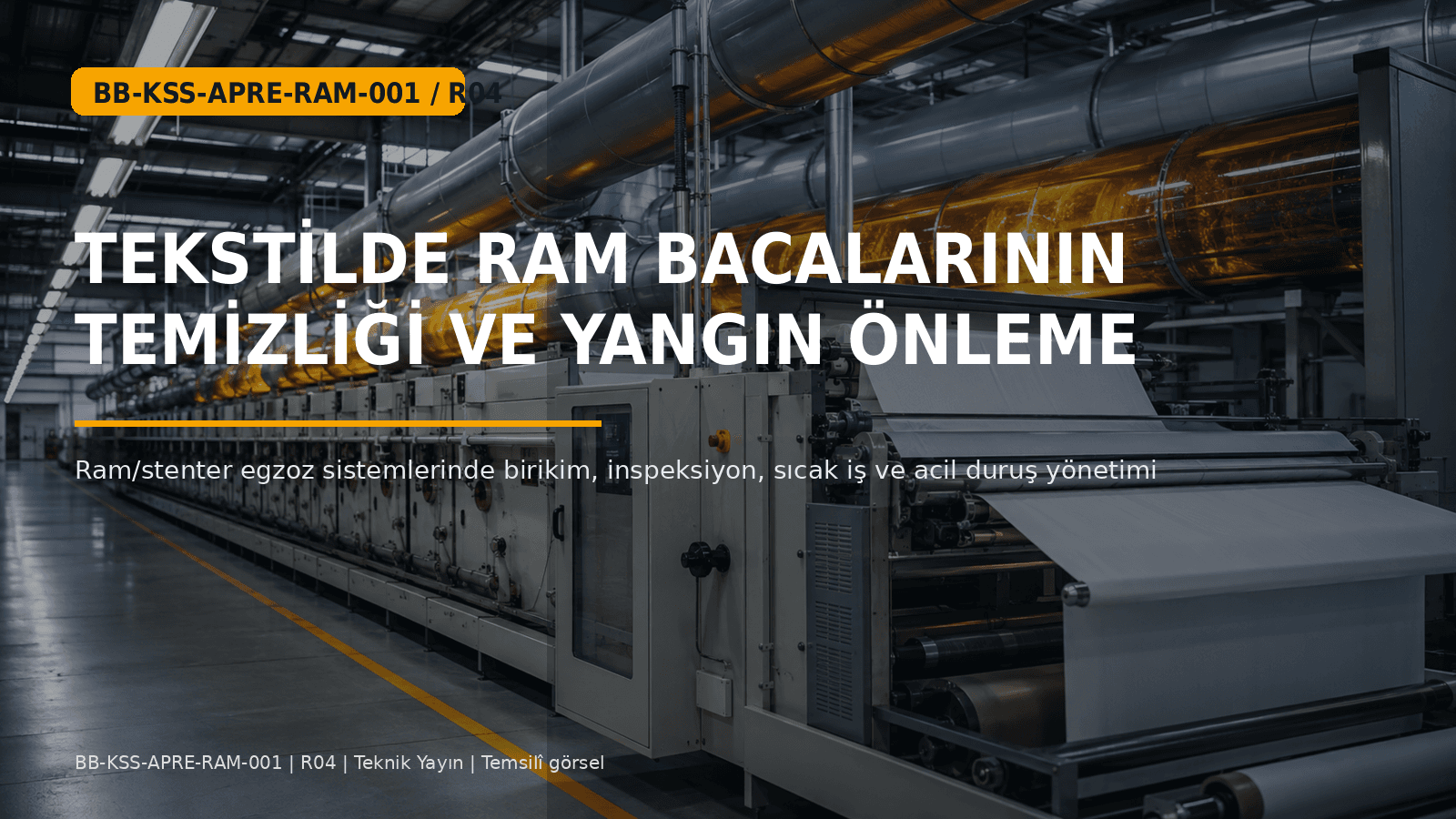
Stenter Exhaust Cleaning and Fire Prevention
Explains how to control lint, oil, wax and aerosol deposits in stenter exhaust systems and manage inspection, cleaning, hot work and emergency response.
Document Control / Doküman Kontrolü
Stenter Exhaust Cleaning and Fire Prevention
Deposits of lint, oil smoke, wax, finishing chemicals and sticky aerosols in stenter exhaust ducts can reduce airflow, increase fan load and create combustible deposits that may help a fire spread through the duct system.
This R04 revision treats exhaust cleaning as a fire-prevention and production-continuity control, not as a delayed maintenance activity. Cleaning intervals must be confirmed by the machine maker's instructions, fabric type, chemical load, operating hours, filter pressure differential, fan airflow, access-port observations and actual deposit data.
Main decision
Cleaning frequency is not a fixed recipe. It must be managed through site evidence, documented inspection and technical approval.
Technical scope
- Stenter exhaust ducts, stacks and roof penetrations
- Filter, ESP, heat-recovery and CIP areas
- Fans, motors, bearings, dampers and airflow indicators
- Access-port inspection system
- Hot-work permit control
- Abnormal odour, smoke, ember/spark signs and emergency shutdown
- Post-incident restart approval
Fire-risk chain
- Fabric, finish, silicone, resin, wax, oil and contaminants are carried into the exhaust system by hot air.
- Low airflow and duct geometry increase aerosol and particle deposition.
- Lint, oil and wax deposits accumulate at elbows, horizontal runs, fan housings, filters and roof penetrations.
- Excess temperature, hot surfaces, electrical faults, friction or hot work can initiate ignition.
- Combustible deposits and fan-induced airflow can support fire spread through the duct route.
Risk-based decision levels
| Level | Typical indicators | Decision |
|---|---|---|
| Low | Low oil/finish load and stable pressure differential | Weekly visual check plus monthly access-port inspection; maintain OEM requirements. |
| Medium | Wax/silicone use, increasing odour or rapid filter loading | Weekly access-port check, monthly photographed inspection and three-month cleaning review. |
| High | Heavy oil/wax aerosol, recurring filter blockage or airflow loss | Daily critical-indicator check, weekly detailed inspection and fixed production cleaning windows. |
| Critical | Smoke, ember/spark signs, abnormal temperature, fan failure or post-hot-work concern | Stop the line, isolate energy, apply the emergency procedure and require technical restart approval. |
Hot-work rule
Welding, grinding or cutting near a stenter duct, fan, stack or roof penetration must not start before deposits are removed, energy is isolated, a hot-work permit is issued, a fire watch is assigned and the close-out inspection is completed.
Emergency principle
Do not open a suspected burning duct and do not apply unauthorised water or chemicals. Bring the line to a safe stop, isolate electrical/heat/gas energy, inform the emergency team and do not restart without a documented technical approval.
Free member downloads
The Technical Master PDF, editable DOCX, carousel PDF and editable PPTX are available to registered members. Users who are not signed in are redirected to the login flow before the requested file is served.
View or download the R04 Technical Master PDF.
Download PDFDownload the editable R04 Technical Master DOCX.
Download DOCXDownload the carousel PDF for team communication.
Download Carousel PDFDownload the editable presentation for site training.
Download PPTXAssess deposit loading, cleaning frequency and fire risk for your actual stenter system.
Request Technical SupportTechnical warning
This publication does not replace the equipment manufacturer's instructions, local regulation, insurance requirements or a site-specific fire-risk assessment. Final cleaning intervals and controls must be validated for the actual plant conditions.
Source groups
The publication uses HSE textile fire-safety guidance, FM Global Data Sheets 7-1, 7-78 and 6-9, the Turkish Ministry of Labour textile-sector inspection report and KMA Filter technical application information.
Continue reading
Related Articles
Finishing
Dimensional Stability Management after Stenter and Compactor
Explains the combined effects of stentering, relaxation and compacting on finished width, GSM, lengthwise and widthwise shrinkage, spirality and dimensional change after laundering.
Dyeing
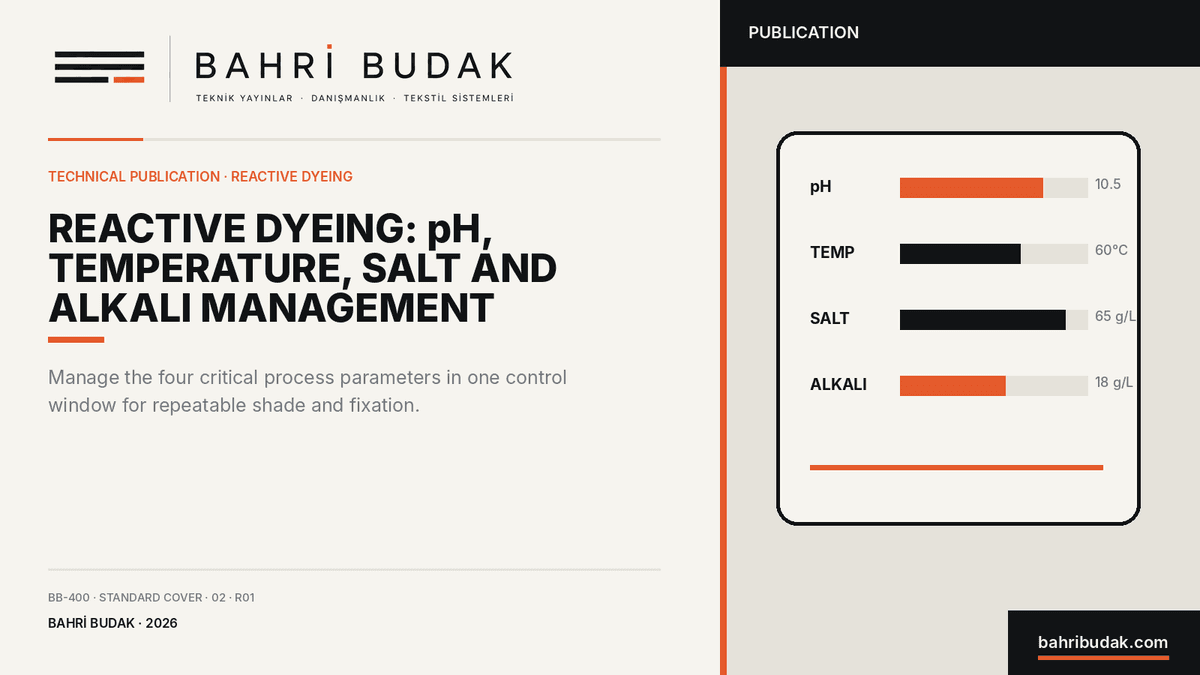
pH, Temperature, Salt and Alkali Management in Reactive Dyeing
Explains the integrated management of pH, temperature, electrolyte, alkali, liquor ratio and dosing profile in exhaust reactive dyeing of cotton and other cellulosic materials.
Knitting
Process Relationship Between Stitch Length, Fabric Weight / GSM and Fabric Width
A field-oriented method for evaluating stitch length, stitch density, GSM, linear-metre mass and finished width in weft-knitted fabrics.
Bahri Budak
Technical publications, training and process consulting based on more than 35 years of field experience in Knitting, Dyeing and Finishing.
LinkedIn →