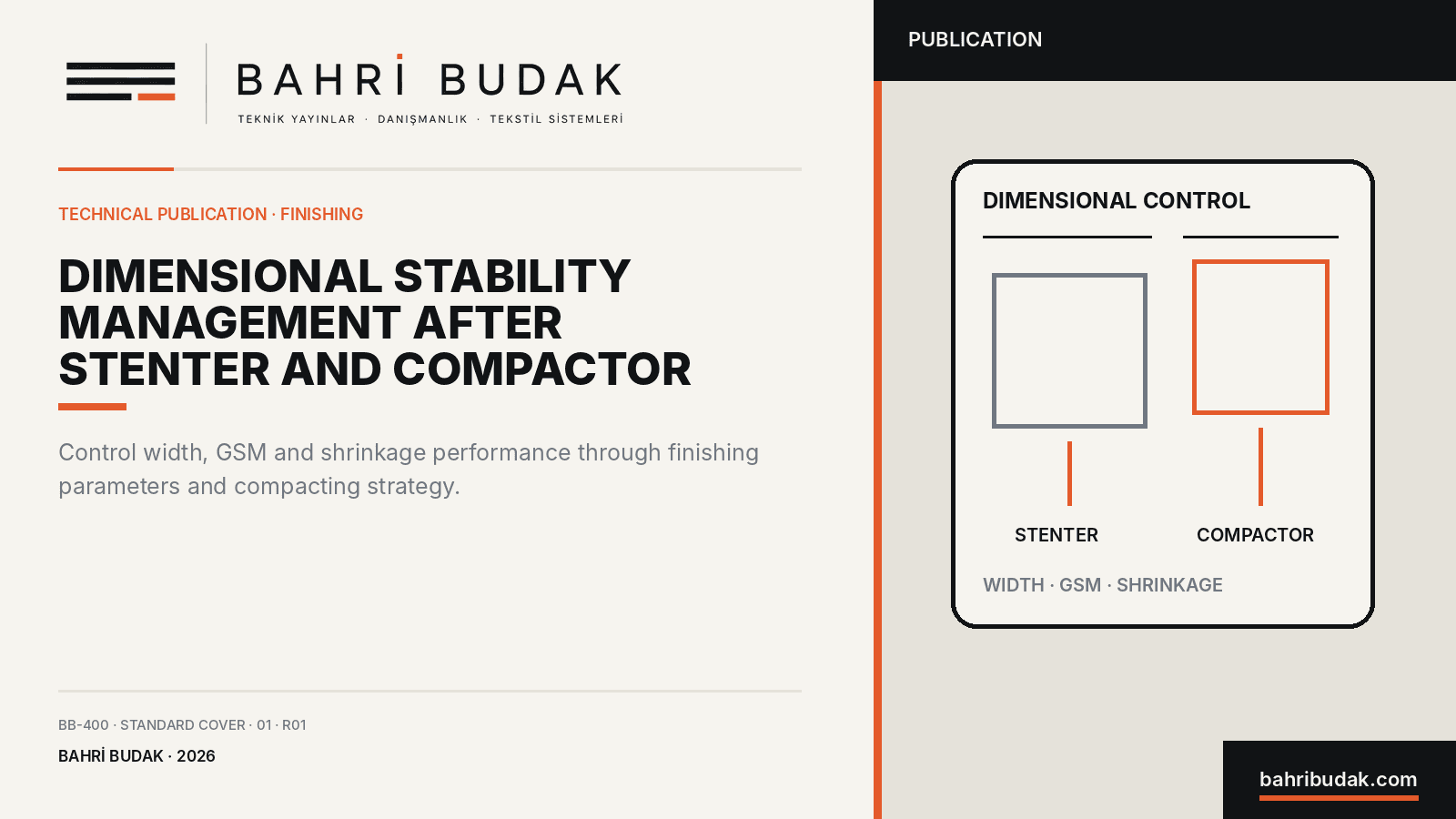
Dimensional Stability Management after Stenter and Compactor
Explains the combined effects of stentering, relaxation and compacting on finished width, GSM, lengthwise and widthwise shrinkage, spirality and dimensional change after laundering.
Document Control / Doküman Kontrolü
1. Purpose / Amaç
This technical publication explains how Stenter / Ramöz, Relaxation / Relaksasyon and Compactor / Kompaktör processes jointly determine dimensional stability, particularly in knitted fabrics made from cotton, viscose and their blends with elastane.
The main shop-floor rule is:
“The stenter controls width and the compactor shortens length” is not a sufficient process model. Dimensional stability is created only when fabric construction, wet-process tension history, drying and relaxation, entry moisture, stenter width and overfeed, actual fabric temperature, compacting conditions and final conditioning are managed as one chain.
The objective is not merely to reduce shrinkage after laundering. The process must simultaneously control:
- Finished width / Bitmiş en
- Mass per unit area (GSM) / Gramaj
- Lengthwise shrinkage / Boyuna çekme
- Widthwise shrinkage / Enine çekme
- Spirality or torque / Spiralite veya dönme
- Handle and bulk / Tuşe ve hacim
- Within-lot and lot-to-lot reproducibility
- Cut-and-sew performance / Konfeksiyon performansı
Image note: The current image is representative. The preferred field photograph should show the stenter entry chain, overfeed mechanism and pinning or clipping point from an approximately 45° angle. A second photograph should show the compacting felt, roll and fabric path from the side. A third photograph should show a specimen marked for dimensional-change testing from a perpendicular top view. Company and operator identities should not be visible.
2. Scope and Technical Boundary / Kapsam ve Teknik Sınır
The publication focuses on:
- Open-width or tubular knitted fabrics
- Cotton, viscose, modal, polyester blends and elastane-containing structures
- Drying, width control and, where applicable, heat-setting or curing on a stenter
- Relaxation drying
- Felt-belt, rubber-belt, Palmer or similar mechanical compaction systems
- Dimensional-change evaluation after domestic washing and drying
The following require separate process validation:
- High-elastane fabrics
- Heat-sensitive fibre blends
- Resin or crosslinking systems for chemical shrinkage control
- Pile, velvet, three-dimensional or surface-sensitive structures
- Coated, laminated or membrane textiles
- Industrial laundering specifications
- Final measurement after garment dyeing or garment washing
Technical warning: This publication does not prescribe a universal stenter temperature, overfeed percentage, chain speed, compactor pressure or felt-system setting. The correct process window must be validated according to polymer type, knit construction, stitch length, elastane content, wet-process tension, machine geometry, customer care instruction and target properties.
3. Origin of Dimensional Instability / Boyutsal Kararsızlığın Kaynağı
Knitted fabric is a flexible structure in which yarn is held in looped rather than straight geometry. Dimensional change is the combined result of:
- Relaxation shrinkage / Relaksasyon çekmesi: Loops stretched during knitting, dyeing, extraction, slitting and transport return toward a lower-energy geometry when released.
- Swelling shrinkage / Şişme çekmesi: Cellulosic fibres swell during wetting and drying cycles, changing yarn and fabric geometry.
- Structural consolidation / Yapı sıkılaşması: Friction and mechanical action cause the structure to become more compact.
- Thermal change / Termal değişim: Thermoplastic fibres relax or acquire a new dimension depending on heat-setting conditions.
- Elastic recovery / Elastik geri dönüş: Elastane and other elastic components recover after process tension.
- Torque and spirality / Tork ve spiralite: Yarn twist, structural asymmetry and process tension rotate wale lines.
Shrinkage is therefore not only a finishing-machine setting. It is the outcome of the fibre–yarn–knitting–dyeing–finishing chain.
4. Actual Function of the Stenter / Ramözün Gerçek İşlevi
A stenter may perform one or several of the following:
- Transport fabric at a controlled width
- Dry the fabric
- Cure a chemical finish
- Heat-set thermoplastic components
- Adjust width, GSM and surface appearance
- Correct bow or skew
- Prepare a reproducible input for compaction
Main variables:
| Variable | Technical effect | Typical risk if mismanaged |
|---|---|---|
| Entry moisture | Heat transfer, relaxation and chemical migration | Uneven drying, handle variation, excess energy |
| Entry tension | Loop elongation and width reduction | Increased length-shrinkage potential |
| Overfeed | Lengthwise relaxation and fabric reserve | Low: elongation; excessive: creasing or unstable pinning |
| Stenter width | Finished width, GSM and crosswise tension | Width shrinkage and low GSM if overstretched |
| Chain speed | Dwell time and production | Incomplete drying or excessive thermal load |
| Zone temperature | Drying, setting or curing | Incomplete process or thermal damage |
| Airflow distribution | Heat and mass transfer across width | Edge-to-centre moisture and temperature variation |
| Fabric temperature | Actual thermal treatment level | Incomplete setting despite correct air setpoint |
| Exit cooling | Stabilisation of dimensions | New tension during hot winding |
| Winding/plaiting tension | Retention of relaxation | Loss of achieved relaxation |
4.1 Entry Moisture
A very dry entry can restrict relaxation in cellulosic knits and alter friction or static behaviour. Excessive or uneven moisture can cause:
- Edge-to-centre drying variation
- Chemical migration
- Unnecessary energy use
- Uneven handle
Entry moisture should be monitored not only as an average but also for distribution across the width.
4.2 Entry Tension
Slitting, squeezing, balloon extraction, vacuum, padding and guide rolls can stretch the fabric lengthwise. Effective relaxation can remain low even with a high displayed overfeed if the fabric is already stretched before pinning.
Check:
- Roll-speed synchronisation
- Dancer or accumulator position
- Edge openers
- Straightener entry tension
- Fabric flow before pinning or clipping
- Whether width opening forcibly stretches the fabric
4.3 Overfeed
Overfeed is the controlled delivery of more fabric relative to chain transport speed. Its purpose is to allow lengthwise relaxation and limit stretching during drying.
PLC calculation conventions vary between machine suppliers. If the speed basis is explicitly defined, an indicative formula is:
Overfeed (%) = ((V_feed - V_chain) / V_chain) x 100
Where:
V_feed: fabric feed speed before pinning or clippingV_chain: stenter chain speed
Technical warning: The percentage displayed by the machine may use a different reference. Verify the supplier’s PLC definition before comparing the display with the formula.
Overfeed alone does not guarantee low shrinkage. Its effect depends on:
- Truly relaxed fabric at entry
- Uniform pin or clip engagement
- Sufficient fabric mobility during drying
- Airflow that does not re-stretch the web
- Low-tension exit and winding
4.4 Width Setting
Finished width is set to meet the product specification, but the maximum width that can be opened is not the same as the stable production width.
Excessive width stretching can cause:
- High crosswise tension
- Loop deformation and lengthwise geometry change
- Lower GSM
- Width shrinkage after laundering
- Edge curl or edge-to-centre variation
Set width by considering:
- Laboratory-relaxed width
- Dyehouse exit width
- Target cuttable width
- Target GSM
- Length and width shrinkage requirements
- Expected width change in compaction
- Elastane recovery
- Cutting-room tolerance
4.5 Temperature, Fabric Temperature and Dwell Time
The air setpoint shown on the stenter is not the actual fabric temperature. When the fabric is wet, much of the energy is used for evaporation; fabric temperature approaches the air setpoint only as drying progresses.
Evaluate:
- Zone air setpoints
- Actual air temperature across width
- Fabric surface or core temperature
- Fabric moisture
- Chain speed
- Effective heated length
- Exhaust and circulating airflow
Indicative geometric dwell time:
t = L_effective / V_chain
Where:
t: theoretical dwell time, minL_effective: effective hot-zone path, mV_chain: chain speed, m/min
Example:
L_effective = 24 m
V_chain = 30 m/min
t = 24 / 30 = 0.80 min = 48 s
This is only geometric residence time. It does not directly show the time for which the fabric remains at target temperature.
5. Relaxation Drying / Relaksasyon Kurutma
A stenter holds the fabric laterally and therefore cannot provide completely free relaxation. Low-tension relaxation drying can be used to:
- Reduce internal stress accumulated during wet processing
- Allow controlled free shrinkage in length and width
- Develop bulk and soft handle
- Present a more stable input to the compactor
A relaxation dryer requires not only low transport tension but also sufficient mechanical action, uniform airflow, appropriate overfeed and a tension-free exit.
Technical boundary: Relaxation drying cannot fully correct an unsuitable construction or severe wet-process stretching. Shrinkage potential must be managed from knitting onward.
6. Actual Function of the Compactor / Kompaktörün Gerçek İşlevi
Compaction mechanically compresses the fabric in the machine direction so that part of the residual length shrinkage is deliberately realised before laundering.
Ideal effects in knits include:
- More rounded loop geometry
- Reduced fabric length
- Increased loop density per unit area
- Controlled increase in GSM and thickness
- Lower residual length shrinkage
A compactor cannot by itself correct:
- Incorrect stitch length or knit construction
- Excessive width setting
- High wet-process tension
- Inadequate relaxation
- Yarn-torque spirality
- Elastane damage
- An unsuitable care procedure
- Within-lot moisture or temperature variation
6.1 Compactor Entry Condition
The fabric should enter:
- At a uniform width
- Under low and stable tension
- At suitable and uniform moisture
- Without creases
- With stable edges
- Centred in the machine
Steaming or moistening can allow yarns to move more easily relative to one another. Excess moisture, however, may cause felt slip, gloss, non-uniform compaction or moisture variation in winding.
6.2 Felt, Belt, Roll and Pressure System
Depending on design, compaction may use:
- Elastic felt
- Rubber belt
- Heated roll
- Shoe
- Palmer cylinder
Monitor:
- Felt or belt surface condition
- Thickness and hardness across width
- Roll parallelism
- Nip or contact pressure
- Roll temperature
- Entry/exit speed synchronisation
- Fabric slip or sticking
- Edge-to-centre compaction
Technical warning: “Increase pressure to reduce shrinkage” is not a safe universal rule. Excess mechanical load may cause gloss, marks, width loss, hard handle, surface damage and elastane degradation.
6.3 Effect on Width and GSM
If dry conditioned mass is assumed constant, GSM rises when area decreases. In real production, moisture, chemical add-on, edge trimming and mass loss affect this simple relationship.
Mass per linear metre:
M_l = G x B
Where:
M_l: mass per linear metre, g/mG: mass per unit area, g/m²B: fabric width, m
Example:
G = 220 g/m²
B = 1.80 m
M_l = 220 x 1.80 = 396 g/m
This is a useful diagnostic for conditioned samples before and after stentering or compaction. It is not a shrinkage acceptance criterion.
7. Dimensional Change Calculation / Boyutsal Değişim Hesabı
For a specimen marked according to the ISO 3759 principle:
D (%) = ((L_after - L_before) / L_before) x 100
Where:
L_before: distance between marks before washing and dryingL_after: distance after washing and drying- Negative result: shrinkage
- Positive result: growth
Length example:
L_before = 500 mm
L_after = 485 mm
D = ((485 - 500) / 500) x 100 = -3.0%
Width example:
L_before = 500 mm
L_after = 495 mm
D = ((495 - 500) / 500) x 100 = -1.0%
Some customer reports show shrinkage as a positive magnitude. The sign convention must be stated in the report and used consistently in the laboratory and ERP system.
8. Measurement and Sampling Discipline / Ölçüm ve Numune Alma Disiplini
Dimensional-change testing is more than putting a specimen in a washing machine. Control the full chain:
- Take representative samples away from distorted edges and from relevant positions within the lot.
- Condition according to the applicable method.
- Mark and measure according to ISO 3759 or customer procedure.
- Wash and dry according to ISO 6330 or the care instruction.
- Calculate according to ISO 5077.
- Evaluate spirality by the applicable separate method.
- Link GSM, width, moisture and appearance to the same lot record.
Recommended sampling points:
- Dyehouse exit
- Stenter entry
- Stenter exit
- Relaxation-dryer exit
- Compactor entry
- Compactor exit
- After 4–24 h conditioning
- After washing and drying
Shop-floor note: Instant width and GSM measured on hot or moist fabric at compactor exit may differ from conditioned values. Free relaxation time and test atmosphere must be standardised.
9. Establishing the Stenter–Compactor Process Window
Build the correct process window by controlled trials and lot data.
9.1 Starting Data
- Fibre blend
- Yarn count and twist
- Knit structure
- Stitch length
- Elastane count and draft
- Greige and dyehouse exit width/GSM
- Wet-process route
- Target finished width/GSM
- Washing and drying procedure
- Customer shrinkage and spirality limits
9.2 Stenter Trial Matrix
Change in a controlled manner:
- Entry tension
- Overfeed
- Width
- Speed/dwell
- Drying-temperature profile
- Fan/airflow
- Exit moisture
Where possible, change only one main variable per trial.
9.3 Compactor Trial Matrix
Change:
- Entry moisture or steam
- Entry tension
- Machine speed
- Mechanical compaction setting
- Felt/belt pressure
- Roll temperature
- Exit winding tension
Evaluate width, GSM, length and width shrinkage, spirality, handle and surface appearance together.
10. Defect–Root Cause–Corrective Action
| Defect | Probable root cause | Verification | Corrective action |
|---|---|---|---|
| High length shrinkage | Wet-process elongation; low effective overfeed; poor relaxation; insufficient compaction | Length data through dyeing, stenter and compactor; speed/tension trends | Reduce entry tension; verify relaxation; optimise compactor moisture and mechanical setting |
| High width shrinkage | Excessive stenter width; high crosswise chain tension; elastane recovery | Relaxed width versus stenter width; width-tension data | Redefine stable width; reduce stretching and chain load |
| Low GSM | Excess width; high length elongation; low conditioning moisture | Width, linear mass and length change | Correct width–length–GSM balance; do not only increase compactor pressure |
| High GSM | Excess compaction; narrow width; high moisture or chemical add-on | Dry GSM, width and linear mass | Verify conditioning basis; rebalance compaction and width |
| Within-lot shrinkage variation | Variation in entry moisture, speed, temperature, tension or felt effect | Head–middle–tail samples and trend records | Set control limits; calibrate sensors and mechanics |
| Edge-to-centre variation | Airflow, padder pressure, felt wear or chain tension variation | Across-width moisture, GSM, temperature and shrinkage | Clean nozzles/filters; correct roll parallelism and felt profile |
| High spirality | Yarn torque; single-jersey asymmetry; wet-process tension; incorrect straightening | Yarn and knitting data; ISO 16322 method | Analyse yarn/knit source; reduce process tension; verify straightening equipment |
| Hard handle | Excess width, overdrying, excessive compaction or incorrect softener | Moisture, stiffness/handle panel and process trends | Reduce thermal/mechanical load; verify softener and add-on |
| Gloss or crushing mark | Excess nip, temperature or felt/belt defect | Surface inspection and pressure profile | Reduce pressure/temperature; maintain felt or belt |
| Uneven elastane recovery | Variable heat history, width tension or elastane damage | Width trend, thermal profile and elastane lot | Validate setting window for polymer and construction |
| Growth after laundering | Overcompaction, unstable structure or drying-method variation | Care procedure and multi-cycle test | Reduce overcompaction; standardise care; assess multi-cycle behaviour |
| Garment panel mismatch | Fabric relaxation, spreading tension or lot mixing | Pre-cutting width/GSM/shrinkage map | Separate lots; standardise spreading and relaxation |
11. Spirality Management / Spiralite Yönetimi
Spirality is not merely a width–length issue that can be permanently corrected on a stenter. Its sources include:
- Yarn twist and torque
- Structural asymmetry such as single jersey
- Machine rotation direction
- Stitch length and take-down
- Rope or tubular tension during wet processing
- Slitting and seam line
- Asymmetric drying or compaction
A bow/skew straightener or differential feed may improve appearance during processing, yet torque may return after laundering. Apply ISO 16322-2 for fabrics or ISO 16322-3 for garments together with the customer specification.
12. Mandatory Process Record Fields
Stenter
- Order, lot, fabric and recipe code
- Fibre blend and elastane content
- Entry width, GSM and moisture
- Padder add-on or extraction level
- Entry tension or dancer setting
- Overfeed setpoint and verified actual feed
- Chain-width profile
- Chain speed
- Zone temperatures
- Fan/airflow setting
- Exhaust setting
- Fabric-temperature or thermal validation
- Exit width, moisture and GSM
- Exit winding/plaiting setting
Compactor
- Entry width, moisture and temperature
- Steam/moistening setting
- Entry tension
- Machine speed
- Felt/belt identification and condition
- Pressure/nip setting
- Roll temperature
- Compaction setting
- Exit width, GSM and moisture
- Winding tension
- Head–middle–tail test results
Laboratory
- Conditioning date and time
- Test standard and machine type
- Wash programme
- Detergent and ballast
- Drying method
- Initial and final measurements
- Length and width dimensional change
- Spirality
- Appearance after laundering
- Operator and instrument calibration
13. Technical Warning on Acceptance Criteria
There is no single universal value for:
- Length shrinkage
- Width shrinkage
- Spirality
- Overfeed
- Stenter width
- Temperature
- Compactor pressure
- Relaxation time
Acceptance criteria must be defined with:
- Customer specification
- Care label
- End use
- Fibre blend
- Knit structure
- Elastane content
- Number of test cycles
- Washing and drying method
- Garment tolerance
- Mill process capability
A fabric that passes after one wash may behave differently in later cycles. Multi-cycle validation may be required for the intended use.
14. Sustainability and Right-First-Time Production
Dimensional-stability defects cause more than quality loss. They consume energy and material through re-finishing, repeated testing, second-quality production and cutting-room waste.
Track:
- Right First Time
- Re-stenter rate
- Re-compactor rate
- Second-quality metres or kilograms
- Cutting waste
- Gas, steam or kWh/kg
- Stenter exhaust temperature and humidity
- Number of repeated tests per fabric
- Customer shrinkage complaints
- Lot-to-lot variation in width, GSM and shrinkage
The largest gain comes not from forcing correction on the last machine, but from building a stable tension and dimension chain from knitting onward.
15. Shop-Floor Control Summary / Saha Kontrol Özeti
- Verify knit construction and stitch length.
- Record dyehouse exit width, GSM and tension history.
- Equalise stenter entry moisture and tension.
- Set width from relaxed fabric data and customer requirements.
- Verify overfeed together with the machine’s calculation convention.
- Monitor actual fabric temperature and exit moisture, not only air setpoint.
- Do not re-introduce tension during exit winding.
- Use low-tension relaxation drying where required.
- Check compactor entry moisture, felt/belt and pressure profile.
- Sample width, GSM and shrinkage at head, middle and tail.
- Condition specimens for a standardised time.
- Apply the ISO or customer wash/dry procedure without alteration.
- Evaluate length shrinkage, width shrinkage and spirality together.
- Close corrective action across the whole process chain, not only at the final machine.
16. References / Kaynaklar
- ISO 3759:2011 — Preparation, Marking and Measuring for Dimensional Change
- ISO 6330:2021 — Domestic Washing and Drying Procedures for Textile Testing
- ISO 5077:2007 — Determination of Dimensional Change in Washing and Drying
- ISO 16322-2:2021 — Determination of Spirality after Laundering: Fabrics
- ISO 16322-3:2021 — Determination of Spirality after Laundering: Garments
- CottonWorks — Shrinkage & Skewing
- CottonWorks — Mechanical Finishing
- CottonWorks — Guide to Improved Shrinkage Performance of Cotton Fabrics
- Santex Rimar — Santacompact RD
- Santex Rimar — Santacompact CK
- Santex Rimar — SantaFrame Stenter
- Brückner — POWER-DRY PD1 Relaxation Dryer
- Brückner — POWER-FRAME Stenter
Referenced Standards / İlgili Standartlar
- ISO 3759:2011 — Preparation, marking and measuring for dimensional change
- ISO 6330:2021 — Domestic washing and drying procedures for textile testing
- ISO 5077:2007 — Determination of dimensional change in washing and drying
- ISO 16322-2:2021 — Determination of spirality after laundering: fabrics
- ISO 16322-3:2021 — Determination of spirality after laundering: garments
Continue reading
Related Articles
Finishing
Stenter Exhaust Cleaning and Fire Prevention
Explains how to control lint, oil, wax and aerosol deposits in stenter exhaust systems and manage inspection, cleaning, hot work and emergency response.
Dyeing
Cupro Blends: Performance, Dyeing and Finishing with Polyester, Modal and Lyocell
Compares dye uptake, HT tolerance, shade uniformity, fibrillation and finishing decisions across three Cupro blends using a controlled validation approach.
Dyeing
Reactive Dyeing of Cupro Fabrics: End-to-End Process Management
A technical publication covering pretreatment, nozzle mechanics, dyestuff selection, process curves, finish stenter chemistry and cost modelling for Cupro reactive dyeing.
Bahri Budak
Technical publications, training and process consulting based on more than 35 years of field experience in Knitting, Dyeing and Finishing.
LinkedIn →