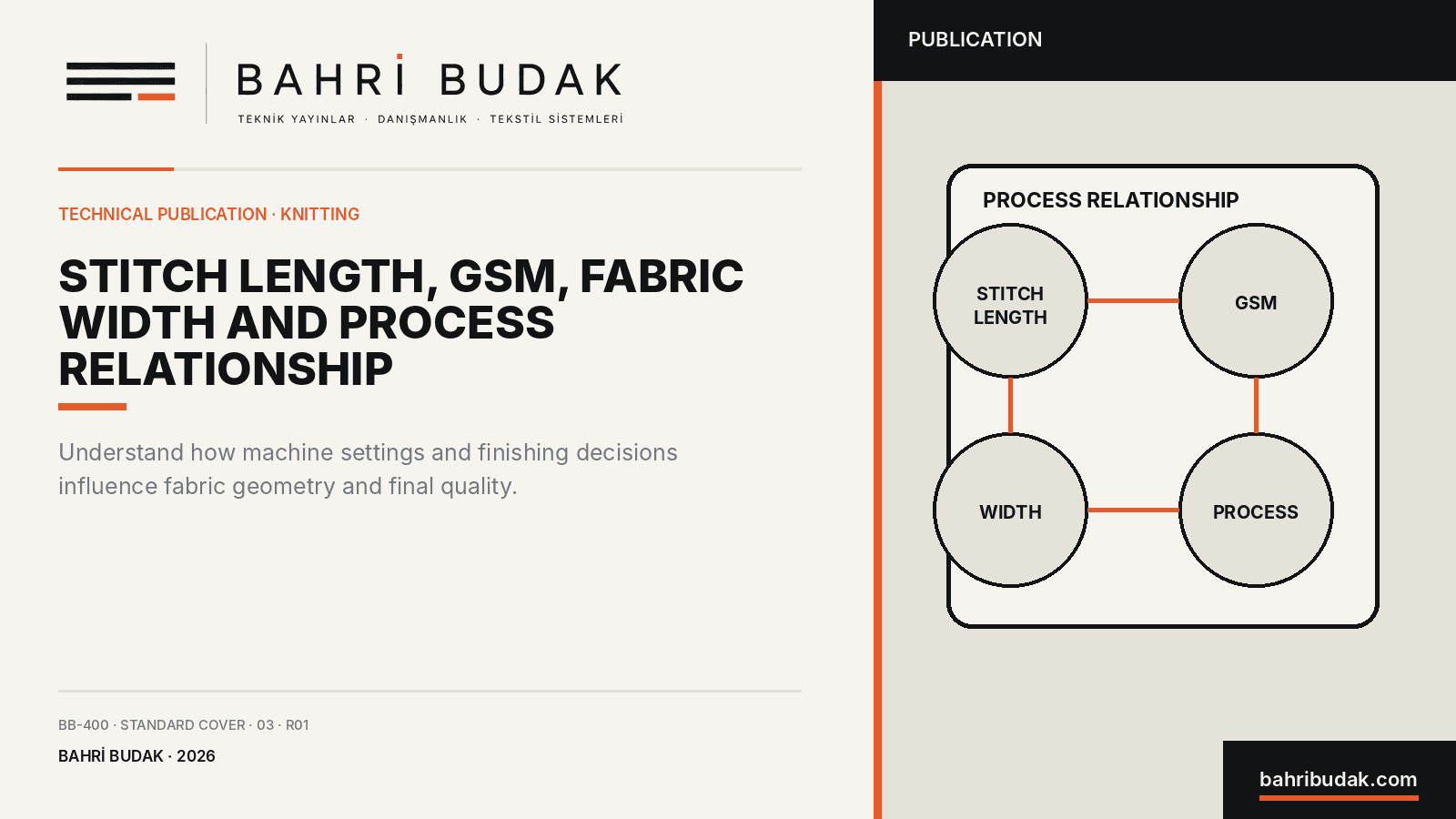
Process Relationship Between Stitch Length, Fabric Weight / GSM and Fabric Width
A field-oriented method for evaluating stitch length, stitch density, GSM, linear-metre mass and finished width in weft-knitted fabrics.
Document Control / Doküman Kontrolü
1. Purpose / Amaç
This technical publication explains how Stitch Length / İlmek Boyu, Mass per Unit Area / Gramaj (GSM) and Fabric Width / Kumaş Eni should be assessed without reducing the result to a single machine setting.
The principal field rule is:
Finished GSM is not determined by stitch length alone. Yarn count, knit structure, active needles, stitch density, take-down, relaxation, wet processing, drying, stentering and compaction must be evaluated together.
The equations below are therefore diagnostic and control tools, not universal recipes.
2. Scope and Assumptions / Kapsam ve Varsayımlar
The discussion is based mainly on weft circular knitting. The same fundamental variables apply to single jersey, rib, interlock, lacoste, fleece, elastane-plated and tuck/miss structures, but structural coefficients and processing behaviour differ.
Valid comparisons require the following to be held constant:
- Fibre composition and yarn count
- Spinning system and twist
- Knit structure
- Machine diameter and gauge
- Active needle count
- Feeder and positive-feed settings
- Take-down
- Elastane draft
- Wet-processing and finishing route
3. Key Definitions / Temel Tanımlar
| Symbol | Definition | Unit |
|---|---|---|
l |
Stitch Length / İlmek Boyu | mm/stitch |
Lc |
Course Length / Sıra Boyu | mm/course |
Na |
Active Needle Count / Aktif İğne Sayısı | count |
T |
Yarn Linear Density / İplik Lineer Yoğunluğu | tex |
C |
Courses per cm / Sıra Sıklığı | courses/cm |
W |
Wales per cm / Çubuk Sıklığı | wales/cm |
S |
Stitch Density = C x W |
stitches/cm² |
G |
Mass per Unit Area / Gramaj | g/m² |
Mf |
Mass per Linear Metre / Lineer Metre Ağırlığı | g/m |
B |
Fabric Width / Kumaş Eni | m |
4. Process Effect of Stitch Length / İlmek Boyunun Proses Etkisi
With yarn, structure, machine and finishing route held constant, increasing stitch length generally produces a more open geometry:
- Stitch density tends to decrease.
- GSM tends to decrease.
- Air permeability and openness may increase.
- Relaxed width may increase.
- Handle may become softer and looser.
Shortening stitch length generally produces the opposite tendency, while yarn tension, needle load and feeding balance become more critical.
Technical warning: Statements such as “longer stitch length always increases width” are incomplete. Finished width is the combined result of knitting width, relaxation, wet-process shrinkage, stenter width, overfeed and compaction.
5. Course Length / Sıra Boyu
For the basic case in which one yarn path forms one loop on every active needle in the relevant course:
Lc = l x Na
Lc: course length, mm/coursel: stitch length, mm/stitchNa: active needles knitting that course
Course length is a strong field-control parameter for yarn delivery and stitch length. The equation must be applied per feeder and per yarn path. Patterned structures, inactive needles, tuck/miss, plating, elastane or multiple yarn paths in one course require separate verification of active loops and yarn consumption.
6. Theoretical GSM Relationship / Teorik Gramaj İlişkisi
G_theoretical = (T x l x C x W) / 100
T: texl: mmC: courses/cmW: wales/cmG_theoretical: g/m²
For yarn count in English cotton count:
tex = 590.5 / Ne
The equation may require structural corrections for tuck/miss, multiple yarns, plating, elastane, pile yarns, chemical add-on, fibre loss and relaxation. It does not replace measured GSM.
7. Worked Example / Hesaplama Örneği
Data:
- Yarn: 30 Ne cotton
- Stitch length: 2.80 mm
- Courses: 20 courses/cm
- Wales: 14 wales/cm
- Relaxed open width: 1.68 m
T = 590.5 / 30 = 19.68 tex
S = 20 x 14 = 280 stitches/cm²
G_theoretical = (19.68 x 2.80 x 20 x 14) / 100
G_theoretical = 154.3 g/m²
Mass per linear metre:
Mf = G x B
Mf = 154.3 x 1.68
Mf = 259.2 g/m
If the same linear mass is spread to a width of 1.74 m:
G = Mf / B
G = 259.2 / 1.74
G = 149.0 g/m²
This demonstrates that GSM changes not only through knitting settings but also through the finished area over which the same mass is distributed.
8. Width–GSM–Linear Mass Relationship / En–Gramaj–Lineer Metre İlişkisi
Mf = G x B
G = Mf / B
B = Mf / G
Units:
Mf: g/mG: g/m²B: open-width fabric width, m
Tubular-fabric warning: If B is the laid-flat tubular width, one linear metre has two fabric faces. The effective area is therefore approximately based on 2 x B:
Mf_tube = G x 2 x B_flat
G = Mf_tube / (2 x B_flat)
This relationship is especially useful after stentering and compaction. Linear mass must not be assumed constant if edge trimming, process loss, moisture variation or chemical add-on occurs. The record must always state whether width is open width or laid-flat tubular width.
9. Stage-to-Stage Mass–Area Balance / Prosesler Arası Kütle–Alan Dengesi
G2 = G1 x Rm / (Rw x Rl)
Rm = M2 / M1: mass-retention ratioRw = B2 / B1: width ratioRl = L2 / L1: length ratio
Example:
G2 = 180 x 0.98 / (1.04 x 0.96)
G2 = 176.7 g/m²
This approach allows width, length and mass changes to be assessed together across pretreatment, dyeing, drying, stentering and compaction.
10. Measurement and Sampling Plan / Ölçüm ve Numune Alma Planı
| Process stage | Mandatory measurements |
|---|---|
| Machine delivery | Course length, stitch length, tube width, take-down, feed setting |
| Relaxed greige | Width, GSM, courses/cm, wales/cm, spirality |
| After pretreatment | Width, GSM, length change, pH, process loss |
| After dyeing | Width, GSM, shrinkage tendency, within-lot variation |
| After stenter | Finished width, overfeed, exit moisture, GSM |
| After compactor | Width, GSM, length shrinkage, compaction setting |
| After laundering | Lengthwise and widthwise dimensional change, spirality |
Samples should be measured without tension after a defined relaxation period. GSM comparisons must use consistent conditioning and moisture conditions.
11. Defect–Root Cause–Corrective Action / Hata–Kök Neden–Düzeltici Faaliyet
| Observation | Possible root causes | Verification | Corrective action |
|---|---|---|---|
| High GSM | Short stitch length; narrow width; high overfeed/compaction; coarser yarn; excessive wet-process shrinkage | Measure stitch length, linear mass, width and density together | Conduct a controlled one-variable trial while protecting width and shrinkage targets |
| Low GSM | Long stitch length; excessive width; insufficient compaction; finer yarn; low stitch density | Verify tex/Ne, course length, C, W and finished width | Correct feeding/take-down and finishing stepwise after confirming yarn and structure |
| Low width | Short stitch length; high take-down; wet-process shrinkage; narrow stenter width; excessive compaction | Trend greige, relaxed, dyed and finished widths | Correct the process stage where the deviation begins; do not hide it only by opening the stenter |
| High width and low GSM | Long stitch length; excessive stenter width; low overfeed; insufficient compaction | Check linear mass and width at the same stage | Optimise width, GSM and dimensional stability together |
| Within-lot GSM variation | Feeder variation, yarn count/moisture variation, unstable take-down, stenter width/moisture variation | Feeder-based course-length checks and roll-based control charts | Feeder calibration, yarn-lot control and process SPC |
12. Shop-Floor Control Sequence / Saha Kontrol Sırası
- Verify fibre, yarn count, twist, lot and moisture.
- Verify machine diameter, gauge, active needles, feeders, cams, positive feed and take-down.
- Measure course length; do not rely only on machine-display settings.
- Measure relaxed greige fabric; machine-delivery width is not the acceptance width.
- Monitor linear-metre mass together with GSM.
- Separate process stages; do not hide a knitting deviation at the stenter.
- Change one variable at a time.
- Confirm the result after laundering and dimensional-stability testing.
13. Technical Warning on Tolerances / Toleranslar Hakkında Teknik İkaz
No universal stitch-length, GSM or width tolerance is specified here. Tolerances must be defined for each product using:
- structure,
- yarn and elastane system,
- customer specification,
- machine repeatability,
- process capability,
- sampling method.
14. References / Kaynaklar
- CottonWorks — Stitch Length
- CottonWorks — Course Length
- CottonWorks — Knit Machinery
- CottonWorks — Shrinkage & Skewing
- CottonWorks — Proper Processing of 100% Cotton Knit Fabrics
- ASTM D3776/D3776M — Mass Per Unit Area of Fabric
- ISO 139:2005 — Standard Atmospheres for Conditioning and Testing
- ISO 22198:2006 — Determination of Fabric Width and Length
- ISO 3759:2011 — Preparation, Marking and Measuring for Dimensional Change
- ISO 6330:2021 — Domestic Washing and Drying Procedures
- AATCC TM135-2025 — Dimensional Changes after Home Laundering
- Flexible Theoretical Calculation of Loop Length and Area Density of Weft-Knitted Structures
Referenced Standards / İlgili Standartlar
- ASTM D3776/D3776M-20(2025) — Fabric Mass per Unit Area
- ISO 139:2005 + Amd 1:2011 — Standard Atmospheres for Conditioning and Testing
- ISO 22198:2006 — Determination of Fabric Width and Length
- ISO 3759:2011 — Preparation, Marking and Measuring for Dimensional Change
- ISO 6330:2021 — Domestic Washing and Drying Procedures
- AATCC TM135-2025 — Dimensional Changes of Fabrics after Home Laundering
Continue reading
Related Articles
Dyeing
Cupro Blends: Performance, Dyeing and Finishing with Polyester, Modal and Lyocell
Compares dye uptake, HT tolerance, shade uniformity, fibrillation and finishing decisions across three Cupro blends using a controlled validation approach.
Dyeing
Reactive Dyeing of Cupro Fabrics: End-to-End Process Management
A technical publication covering pretreatment, nozzle mechanics, dyestuff selection, process curves, finish stenter chemistry and cost modelling for Cupro reactive dyeing.
Finishing
Stenter Exhaust Cleaning and Fire Prevention
Explains how to control lint, oil, wax and aerosol deposits in stenter exhaust systems and manage inspection, cleaning, hot work and emergency response.
Bahri Budak
Technical publications, training and process consulting based on more than 35 years of field experience in Knitting, Dyeing and Finishing.
LinkedIn →