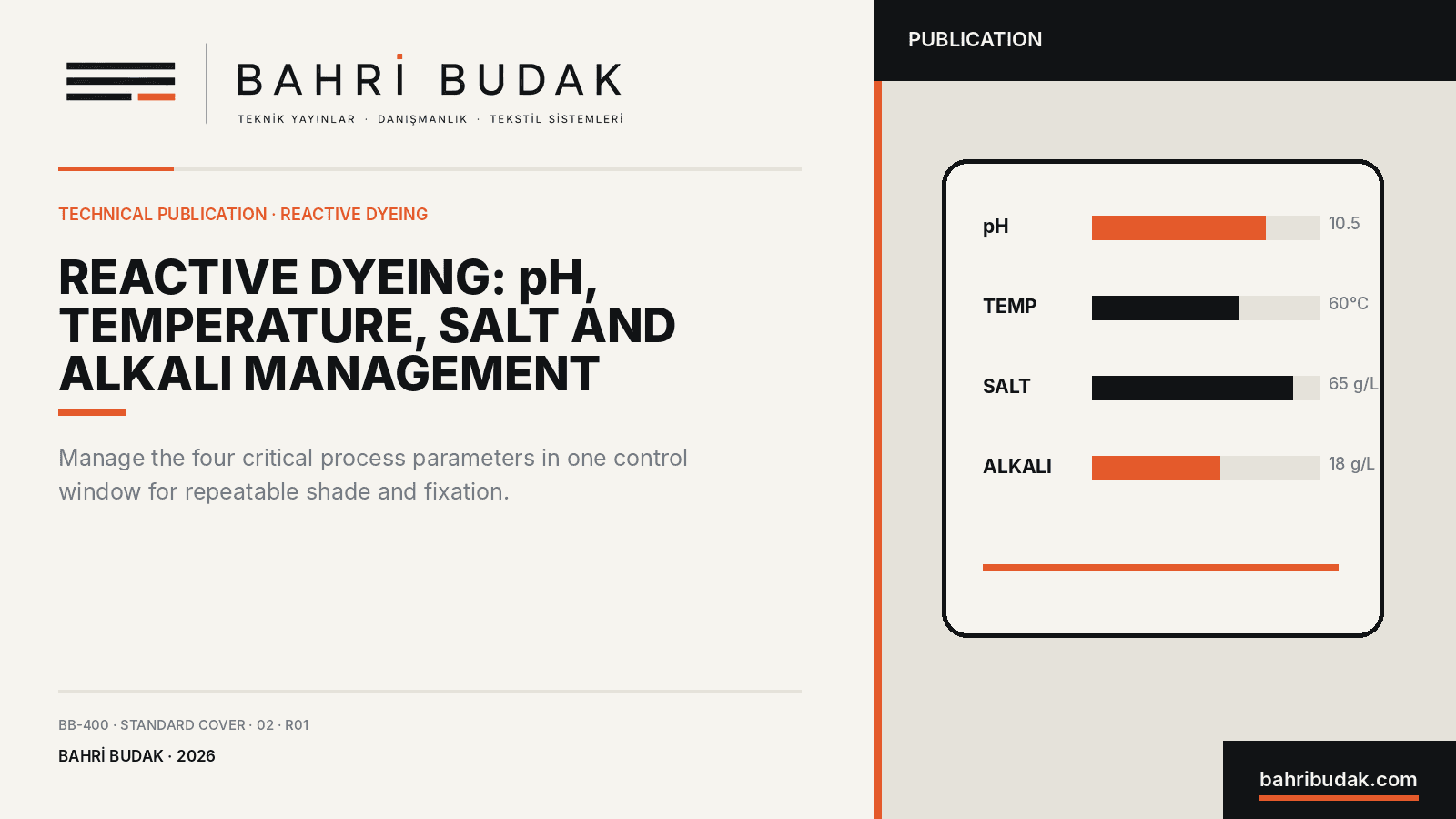
pH, Temperature, Salt and Alkali Management in Reactive Dyeing
Explains the integrated management of pH, temperature, electrolyte, alkali, liquor ratio and dosing profile in exhaust reactive dyeing of cotton and other cellulosic materials.
Document Control / Doküman Kontrolü
1. Purpose / Amaç
This technical publication explains how pH, Temperature / Sıcaklık, Salt–Electrolyte / Tuz–Elektrolit and Alkali / Alkali must be managed as parts of one reaction system during Exhaust Reactive Dyeing / Çektirme Yöntemiyle Reaktif Boyama of cotton and other cellulosic materials.
The main shop-floor rule is:
Salt does not chemically fix the dye to the fibre. It supports the approach and exhaustion of the dye onto cellulose. Covalent fixation is enabled by cellulose activated under alkaline conditions. The same alkali and temperature that accelerate dye–fibre reaction can also accelerate dye hydrolysis in water.
The target is therefore not merely a dark shade. The process must simultaneously deliver Levelness / Düzgünlük, Reproducibility / Tekrarlanabilirlik, Fixation / Fiksaj, Wash Fastness / Yıkama Haslığı, Wet Rubbing Fastness / Yaş Sürtme Haslığı and a low reprocessing rate.
Image note: The current process image is representative. The preferred field photograph should show the dyeing-machine sampling point together with the pH probe or dosing line, from an approximately 45° angle and without company-identifying information.
2. Scope and Technical Boundary / Kapsam ve Teknik Sınır
The publication focuses on:
- Cotton, viscose and similar cellulosic fibres
- Knitted or woven fabrics
- Exhaust reactive dyeing
- Single-bath or controlled multi-stage processes
- Conventional salt–alkali systems
The following applications use related control principles but require separate validation:
- Cationized Cotton / Katyonize Pamuk
- Salt-free or low-salt speciality systems
- Cold Pad-Batch
- Pad–Steam and continuous dyeing
- Reactive printing
- Reactive dyes on protein fibres or polyamide
- Special buffered or neutral fixation systems
Technical warning: The pH and temperature ranges in this publication are general process windows, not universal recipes. The dye supplier’s Technical Data Sheet (TDS) / Teknik Veri Föyü and mill validation always take precedence. A change in reactive-group chemistry can require a different temperature, alkali system, dosing time and fixation time.
3. Reaction Logic / Reaksiyon Mantığı
Three events proceed together in reactive dyeing:
- Exhaustion / Banyodan Çekim: Transport of the anionic dye from the bath to the cellulose surface.
- Diffusion / Lif İçine Difüzyon: Movement of dye into accessible fibre regions.
- Covalent Fixation / Kovalent Bağlanma: Reaction of the reactive group with activated cellulose.
Simplified activation:
Cell-OH + OH- <=> Cell-O- + H2O
Simplified fixation:
Dye-X + Cell-O- -> Dye-O-Cell + X-
Undesired hydrolysis:
Dye-X + OH- / H2O -> Dye-OH
Where:
Cell-OH: cellulose hydroxyl groupCell-O-: cellulose activated under alkaline conditionsDye-X: dye containing an active reactive groupDye-OH: hydrolysed dye that can no longer form a covalent bond with the fibre
These equations are simplified. The actual mechanism differs for monochlorotriazine, vinyl sulfone, bifunctional and polyfunctional reactive groups.
4. Four Main Process Variables / Dört Ana Proses Değişkeni
4.1 pH Management / pH Yönetimi
pH determines cellulose activation and dye reactivity.
- A neutral or near-neutral phase supports controlled exhaustion and distribution.
- Alkali activates cellulose and starts covalent fixation.
- If pH remains too low, fixation can be inadequate.
- If pH rises too fast or too high, local fixation, unlevelness and hydrolysis risk increase.
Many conventional systems may operate at approximately pH 10.5–11.5 during fixation. This is not a universal recipe and must be validated together with dye class, alkali system, liquor ratio and temperature.
Measurement discipline:
- Calibrate the pH meter daily or at the start of the shift with suitable buffers.
- Do not compare pH readings taken at uncontrolled sample temperatures.
- Keep the mill measurement method constant even when automatic temperature compensation is used.
- Record the pH profile throughout alkali dosing, not only at the beginning and end.
4.2 Temperature Management / Sıcaklık Yönetimi
Temperature simultaneously affects diffusion, reaction rate and hydrolysis rate.
General classification:
| Reactive system | General temperature approach | Technical note |
|---|---|---|
| Cold-reactive / Soğuk tip | approximately 30–40 °C | High reactivity; alkali and dwell time are critical |
| Warm-reactive / Ilık tip | approximately 50–60 °C | Many bifunctional systems operate in this region |
| Hot-reactive / Sıcak tip | approximately 70–80 °C | Lower reactivity may require higher temperature |
This table is only a classification. Recommended temperatures can differ even within one commercial dye range.
Critical shop-floor points:
- Do not start fixation time before the full load reaches target temperature.
- Define the heating rate together with machine load and circulation.
- Verify actual bath temperature; do not rely only on the controller set value.
- Temperature variation can magnify shade variation, especially when it overlaps with alkali dosing.
4.3 Salt–Electrolyte Management / Tuz–Elektrolit Yönetimi
Cellulose and reactive dye are generally negatively charged in the dyebath. Sodium Chloride / Sodyum Klorür or Sodium Sulfate / Sodyum Sülfat reduces the effect of electrostatic repulsion and supports dye approach and exhaustion onto the fibre.
Salt:
- Increases exhaustion.
- Changes the exhaustion rate.
- Influences the levelness–migration balance.
- Raises ionic strength and conductivity.
Salt does not:
- Create covalent fixation by itself.
Excessive or rapid salt addition can cause:
- Sudden surface exhaustion,
- Head–tail, inside–outside or centre–edge variation,
- Low migration,
- Increased unlevelness risk.
Insufficient salt or low effective ionic strength can cause:
- Low exhaustion,
- Pale shade,
- Excess dye remaining in the bath,
- Low overall colour yield.
Conductivity warning: Conductivity is useful for monitoring electrolyte addition, but salt type, alkali, temperature, water hardness and other ions affect the reading. Do not use a universal “mS/cm = g/L salt” conversion. Establish a mill-specific calibration curve at controlled temperature.
4.4 Alkali Management / Alkali Yönetimi
Common alkali sources include:
- Soda Ash / Sodium Carbonate
- Caustic Soda / Sodium Hydroxide
- Sodium Bicarbonate
- Buffered commercial alkali systems
Alkali selection depends on:
- Reactive-group chemistry
- Shade depth
- Dye combination
- Liquor ratio
- Temperature
- Dosing time
- Machine circulation
- Required fixation profile
A single-point addition of concentrated alkali can create a local pH spike. The result may be rapid local fixation, staining, shade variation or poor reproducibility.
A controlled approach is to:
- Prepare alkali solution at a validated concentration,
- Ensure complete dissolution and filtration,
- Use stepped or linear dosing,
- Relate dosing time to machine rotation and bath turnover time,
- Check backflow and dead volume in the dosing line,
- Verify the pH profile with actual bath samples.
5. Liquor Ratio and Machine Hydrodynamics / Flotte Oranı ve Makine Hidrodinamiği
The same recipe percentage does not create the same g/L value at a different Liquor Ratio (LR) / Flotte Oranı or effective bath volume.
Definition:
LR = Bath volume (L) / Fabric mass (kg)
Approximate bath volume:
V = M x LR
Where:
V: effective bath volume, LM: fabric mass, kgLR: L/kg
Actual machine volume can differ because of pipe dead volume, filter, heat exchanger, dosing vessel and liquor retained by the fabric. Use the validated effective machine volume for recipe calculations.
Hydrodynamic controls include:
- Nozzle pressure and diameter
- Fabric speed and cycle time
- Pump flow
- Loading ratio
- Rope opening
- Filter cleanliness
- Foam and air locks
- Mixing time after dosing
6. Recommended Process Control Sequence / Önerilen Proses Kontrol Sırası
Stage 1 — Pre-check / Ön Kontrol
- Verify fabric lot, mass and loading quantity.
- Check pretreatment uniformity, absorbency and residual peroxide.
- Record water pH, hardness and conductivity.
- Verify dye and chemical lots.
- Check machine cleanliness, filter and dosing lines.
Stage 2 — Dye Admission and Homogenization / Boya Alımı ve Homojenizasyon
- Fully dissolve or disperse dye in suitable water.
- Filter according to supplier instructions.
- Admit dye to the bath in a controlled manner.
- Allow one or more validated bath turnovers for homogenization.
Stage 3 — Salt-assisted Exhaustion / Tuzla Çekim
- Dose salt in steps or linearly according to the validated recipe.
- Allow sufficient circulation after each step.
- Monitor conductivity and sample shade together.
- Delay the next step if rapid surface exhaustion is observed.
Stage 4 — Temperature Stabilization / Sıcaklık Stabilizasyonu
- Heat at a controlled rate.
- Do not start alkali fixation until actual bath temperature is stable.
- Use independent measurement if internal temperature uniformity is doubtful.
Stage 5 — Alkali Fixation / Alkaliyle Fiksaj
- Dose alkali in steps or linearly.
- Record pH at the start, intermediate points and end of dosing.
- Start fixation time only after final alkali addition and sufficient bath homogenization.
- Take cycle-based intermediate samples when required.
Stage 6 — Rinsing, Neutralization and Washing-off / Durulama, Nötralizasyon ve Yıkama
- Remove free electrolyte and alkali by controlled rinsing.
- Neutralize at the validated stage.
- Remove hydrolysed and unfixed dye with an adequate time–temperature–chemical combination.
- Verify final bath pH and fabric-extract pH against customer requirements.
7. Indicative Process Window / Gösterge Proses Penceresi
This table is a control logic, not a recipe:
| Process stage | Main variable | General target |
|---|---|---|
| Dye admission | pH, dissolution, filtration, temperature | Homogeneous distribution before fixation |
| Salt dosing | Conductivity, dosing time, bath turnovers | Controlled and level exhaustion |
| Heating | Actual temperature, heating rate | Uniform temperature throughout the load |
| Alkali dosing | pH profile, dosing curve, cycle time | Fixation without local pH spikes |
| Fixation | pH, temperature, time, intermediate shade | Target colour yield and reproducibility |
| Washing-off | pH, temperature, time, bath clarity | Removal of hydrolysed dye |
| Final control | ΔE, K/S, wash and rubbing fastness | Conformance to specification |
8. Dosing Calculations / Dozaj Hesapları
8.1 Salt Quantity / Tuz Miktarı
Salt (kg) = Target concentration (g/L) x Effective bath volume (L) / 1000
8.2 Commercial Alkali Quantity / Ticari Alkali Miktarı
Commercial alkali (kg)
= Pure active target (g/L) x Bath volume (L)
  / [1000 x Product active fraction]
Use the active fraction as a decimal. For 99% purity, use 0.99.
8.3 Worked Example / Hesaplama Örneği
Data:
- Fabric: 400 kg
- Liquor ratio: 1:6
- Effective bath volume: 2,400 L
- Salt target: 50 g/L
- Pure soda target: 12 g/L
- Commercial soda purity: 99%
Bath volume:
V = 400 x 6 = 2,400 L
Salt:
Salt = 50 x 2,400 / 1000
Salt = 120.0 kg
Commercial soda ash:
Commercial soda = 12 x 2,400 / (1000 x 0.99)
Commercial soda = 29.1 kg
Technical warning: The 50 g/L and 12 g/L values are used only to demonstrate the calculation. They are not dyeing recommendations. Actual targets must be based on dye combination, shade depth, reactive group, LR and TDS.
9. Exhaustion, Colour Yield and Fixation Indicators / Çekim, Renk Verimi ve Fiksaj Göstergeleri
Approximate exhaustion by dyebath absorbance:
E (%) = [(A0 - At) / A0] x 100
Where:
A0: initial dyebath absorbanceAt: absorbance at time tE: approximate exhaustion percentage
Keep dilution ratio, wavelength, cuvette, temperature and turbidity procedure constant.
Colour-strength retention before and after washing-off:
Colour-strength retention (%)
= (K/S_after washing-off / K/S_before washing-off) x 100
This is not an absolute chemical fixation percentage. It is an operational comparison indicator for the same fabric, dye combination and measurement conditions.
Evaluate colour difference as:
ΔE_CMC(l:c)
under identical measurement geometry and conditions, using the ISO 105-J03 approach. Define acceptance limits from the customer specification.
10. Measurement and Sampling Plan / Ölçüm ve Numune Alma Planı
| Sampling point | Measurement |
|---|---|
| Fresh water | pH, hardness, conductivity, temperature |
| After dye admission | pH, temperature, visual homogeneity |
| Before salt | Initial absorbance or reference sample |
| After each salt step | Conductivity, cycle count, intermediate shade |
| Start of alkali dosing | pH, temperature, cycle time |
| Alkali intermediate points | pH, conductivity, percentage dosed |
| End of alkali dosing | Final pH, temperature, homogenization time |
| Mid and end fixation | Intermediate shade, bath absorbance, process time |
| End of washing-off | Bath clarity, pH, conductivity |
| Finished fabric | ΔE, K/S, extract pH, wash and rubbing fastness |
11. Defect–Root Cause–Corrective Action / Hata–Kök Neden–Düzeltici Faaliyet
| Observed defect | Possible root cause | Verification | Corrective action |
|---|---|---|---|
| Unlevel dyeing | Salt or alkali too fast; poor circulation; local pH; temperature difference | Dosing graph, cycle time, pH trend, machine flow | Extend dosing; redefine steps; verify circulation and mixing |
| Pale shade / low K/S | Low exhaustion; insufficient alkali; inadequate fixation temperature/time; hydrolysis | Bath absorbance, pH, temperature and time trend | Correct the salt–alkali–temperature profile by single-variable trials and TDS |
| Dark shade | Excess exhaustion; effective-volume error; weighing or dye-strength variation | Bath volume, weighing, dye lot, conductivity | Calibrate machine volume; verify weighing and recipe transfer |
| Batch-to-batch variation | Water quality, LR, dosing time, pH or dye-lot variation | Batch comparison graph | Apply SPC limits; record water and chemical lots |
| Poor wet rubbing | Inadequate washing-off; redeposition of hydrolysed dye; surface dyeing | Wash bath, surface K/S, wet crock test | Optimize rinse–neutralize–soap sequence and dispersing system |
| Poor wash fastness | Unfixed dye; inadequate fixation or washing-off | ISO 105-C06 and process samples | Verify fixation; improve washing-off temperature, time and bath count |
| Dye spots | Incomplete dissolution; missing filtration; hard water; local alkali | Filter residue, particles, hardness | Correct dissolution, filtration, sequestering and dosing lines |
| Head–tail variation | Rapid exhaustion; dosing-line dead volume; sampling timing | First/last cycle samples, dosing-line check | Redesign dosing entry and mixing time |
| High fabric pH | Inadequate neutralization or rinsing | ISO 3071 extract pH | Correct neutralization quantity and rinse sequence |
12. Mandatory Process Record Fields / Proses Kayıt Formunda Zorunlu Alanlar
- Order, shade, fabric and lot code
- Machine number and nominal load
- Actual fabric mass
- Effective bath volume and LR
- Water pH, hardness and conductivity
- Dye name, batch number and weighed quantity
- Salt type, batch, quantity and dosing time
- Alkali type, activity, quantity and dosing time
- Heating rate and actual temperature trend
- pH trend
- Conductivity trend
- Fabric cycle time
- Intermediate sample times and ΔE/K/S results
- Washing-off steps
- Final fastness and extract-pH results
- Deviation, intervention and reprocessing record
13. Safety and Chemical Preparation / Güvenlik ve Kimyasal Hazırlama
- Prepare alkali solutions with suitable personal protective equipment.
- Add concentrated caustic soda to water slowly and under control; account for splashing and exothermic heat.
- Prepare dye and chemical solutions at validated temperatures.
- Do not mix incompatible chemicals in one preparation vessel.
- Clean dosing tanks, lines and valves during product change.
- The Safety Data Sheet (SDS) and mill safety procedure take precedence.
14. Technical Warning on Acceptance Criteria / Kabul Kriteri Hakkında Teknik İkaz
This publication does not define a universal:
- Salt g/L,
- Alkali g/L,
- pH tolerance,
- Fixation time,
- Heating rate,
- ΔE limit,
- Fastness grade.
Acceptance criteria must be based on dye range, customer specification, shade depth, fibre blend, machine type, LR, water quality and mill process capability.
Especially important: Two dye combinations operating at the same pH and temperature may not accept the same dosing profile because their reactive-group compatibility and exhaustion kinetics differ.
15. Sustainability and Right-First-Time Production / Sürdürülebilirlik ve İlk Seferde Doğru Üretim
Environmental improvement in reactive dyeing is not limited to lowering salt or water. A major gain is Right First Time (RFT) / İlk Seferde Doğru production.
Monitor:
- kg salt / kg fabric
- kg alkali / kg fabric
- L water / kg fabric
- kWh / kg fabric
- Steam / kg fabric
- Right-first-time rate
- Correction and redye rate
- Number of washing-off baths
- Effluent COD, colour and conductivity load
When applying low-salt or high-fixation dye systems, do not transfer the conventional recipe directly. Validate through laboratory, pilot and production trials.
16. Shop-Floor Control Summary / Saha Kontrol Özeti
- Verify pretreatment and residual peroxide.
- Verify effective bath volume and LR.
- Fully dissolve, filter and homogenize dye.
- Dose salt under control; monitor conductivity with a mill calibration.
- Stabilize target temperature throughout the load.
- Dose alkali in steps or linearly according to bath turnover time.
- Record pH throughout dosing, not only at the end.
- Start fixation timing from the actual homogenization point.
- Remove hydrolysed dye by the correct rinse–neutralize–wash-off sequence.
- Close colour, fastness and fabric-extract pH in the same batch record.
17. References / Kaynaklar
- CottonWorks — Dyeing Basics
- CottonWorks — Textile Dyeing Booklet
- DyStar — Cadira Reactive Brochure
- DyStar — Sera ECO WASH
- ISO 3071:2020 — Determination of pH of Aqueous Extract
- ISO 105-C06:2010 — Colour Fastness to Domestic and Commercial Laundering
- ISO 105-X12:2016 — Colour Fastness to Rubbing
- ISO 105-E04:2013 — Colour Fastness to Perspiration
- ISO 105-J03:2009 — Calculation of Colour Differences
- AATCC TM61 — Colorfastness to Laundering: Accelerated
- AATCC TM8 — Colorfastness to Crocking: Crockmeter
- Eco-friendly Salt/Alkali-free Exhaustion Dyeing of Cotton Fabric with Reactive Dyes
Referenced Standards / İlgili Standartlar
- ISO 3071:2020 — Determination of pH of aqueous extract
- ISO 105-C06:2010 — Colour fastness to domestic and commercial laundering
- ISO 105-X12:2016 — Colour fastness to rubbing
- ISO 105-E04:2013 — Colour fastness to perspiration
- ISO 105-J03:2009 — Calculation of colour differences
Continue reading
Related Articles
Dyeing
Cupro Blends: Performance, Dyeing and Finishing with Polyester, Modal and Lyocell
Compares dye uptake, HT tolerance, shade uniformity, fibrillation and finishing decisions across three Cupro blends using a controlled validation approach.
Dyeing
Reactive Dyeing of Cupro Fabrics: End-to-End Process Management
A technical publication covering pretreatment, nozzle mechanics, dyestuff selection, process curves, finish stenter chemistry and cost modelling for Cupro reactive dyeing.
Finishing
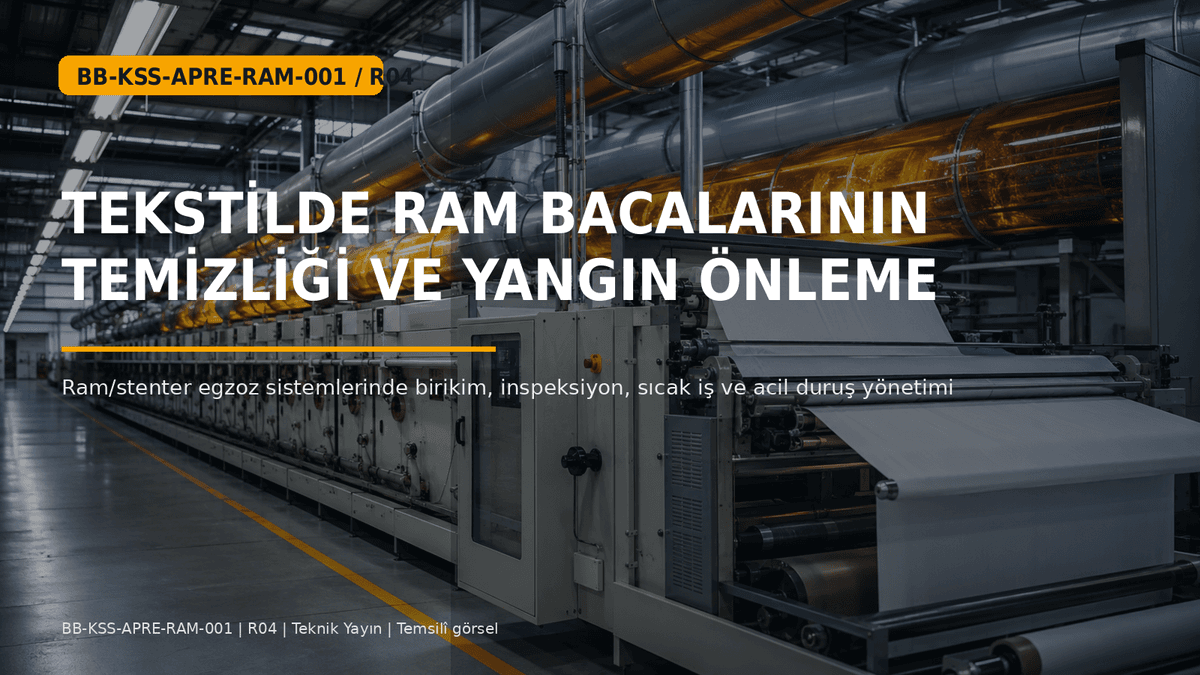
Stenter Exhaust Cleaning and Fire Prevention
Explains how to control lint, oil, wax and aerosol deposits in stenter exhaust systems and manage inspection, cleaning, hot work and emergency response.
Bahri Budak
Technical publications, training and process consulting based on more than 35 years of field experience in Knitting, Dyeing and Finishing.
LinkedIn →