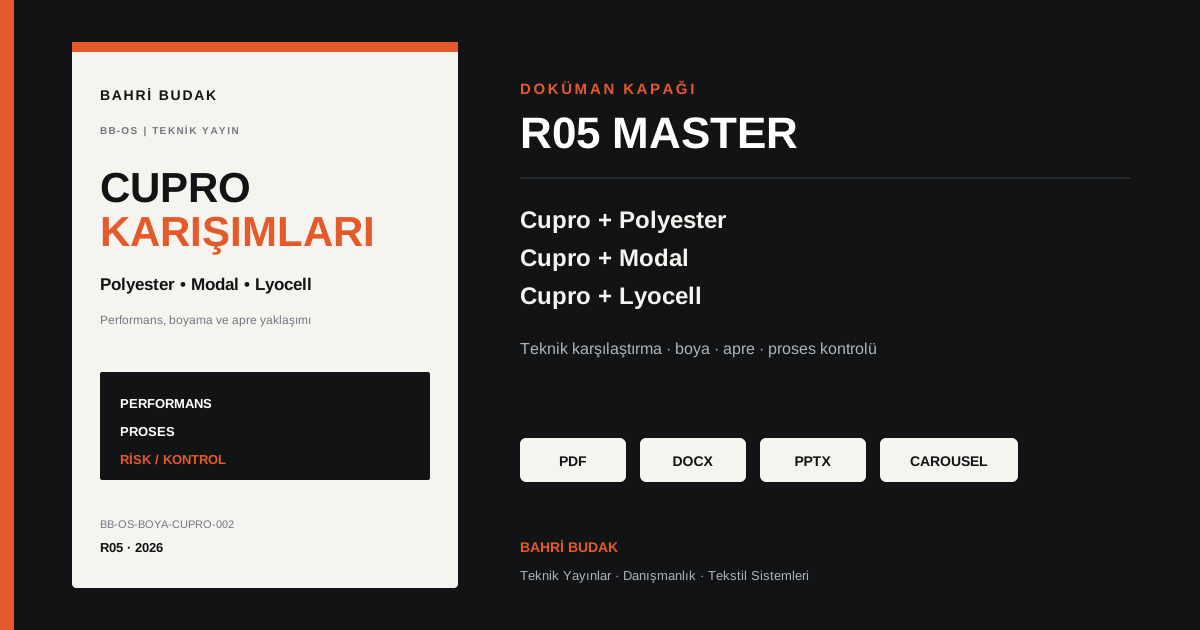
Cupro Blends: Performance, Dyeing and Finishing with Polyester, Modal and Lyocell
Compares dye uptake, HT tolerance, shade uniformity, fibrillation and finishing decisions across three Cupro blends using a controlled validation approach.
Document Control / Doküman Kontrolü
Publication files
Downloadable Technical Files
Cupro Blends: Polyester, Modal and Lyocell
Cupro blends with polyester, Modal and Lyocell should not be managed with a single process logic. Fibre characteristics, dyestuff class, thermal behaviour, dye uptake, fibrillation tendency and target handle must be evaluated together.
Three blends, three different control problems
- Cupro + Polyester: HT disperse conditions must be validated together with the wet and thermal tolerance of Cupro.
- Cupro + Modal: Dye uptake, fixation and shade uniformity become the main controls.
- Cupro + Lyocell: Wet mechanical action and fibrillation control are critical.
Cupro + Polyester
Polyester is thermoplastic and hydrophobic, while Cupro is a regenerated cellulosic fibre. Disperse and reactive dyeing stages therefore require separate control based on the actual fabric and machine conditions.
Where pre-setting (heat setting) is required, temperature and time must be established through stenter trials on the actual blend. The effect of the polyester HT profile on Cupro must be validated by laboratory or pilot trials.
For dark shades, the need for reduction clearing of unfixed disperse dye remaining on the polyester surface should be assessed according to dyestuff class, shade depth and target fastness.
Cupro + Modal
Both fibres are regenerated cellulosics and have a hydrophilic structure. A common reactive dyeing process can be technically feasible, but the dye uptake rates and fixation behaviour of Cupro and Modal must not be assumed to be identical.
Shade uniformity should be validated through dye uptake curves, alkali addition, heating rate, circulation and actual fabric trials. A levelling agent may be used where required, but it cannot guarantee shade uniformity on its own.
Cupro + Lyocell
Fibrillation is a known process risk for Lyocell, and Cupro can also fibrillate under suitable wet and mechanical conditions. Mechanical action, fabric movement and surface change therefore need to be controlled together.
Biopolishing with cellulase may be applied, but it is not mandatory for every Cupro + Lyocell fabric. Enzyme temperature, pH, dosage, treatment time and deactivation conditions must be defined according to the product TDS.
Where crease risk is present, a suitable anti-crease textile auxiliary should be used only when required by the actual fabric and process and in accordance with its TDS.
Finishing and stenter approach
Silicone type, overfeed, width/length tension and stenter temperature should not be fixed as one universal recipe. Target handle, hydrophilicity, dimensional change, GSM, width, colour change, fastness and seam performance should be evaluated together on the actual fabric.
Technical application boundary
This publication is a technical guide. Process set values such as temperature, pH, time and dyestuff/auxiliary dosage must be validated against the actual blend ratio, fabric construction, machine conditions, product TDS/SDS data and laboratory/pilot results.
Cost comparisons should not be generalised without current raw-material prices, energy and water use, machine time, chemical consumption and reprocessing data.
Member-only technical files
The R05 Master PDF, editable DOCX, PPTX and Carousel PDF are delivered through the member-controlled download flow. Process set values must be validated against the actual fabric, TDS/SDS data and laboratory/pilot results before being used as a production recipe.
Referenced Standards / İlgili Standartlar
- BB-OS v3.9 REV.15
Continue reading
Related Articles
Dyeing
Reactive Dyeing of Cupro Fabrics: End-to-End Process Management
A technical publication covering pretreatment, nozzle mechanics, dyestuff selection, process curves, finish stenter chemistry and cost modelling for Cupro reactive dyeing.
Dyeing
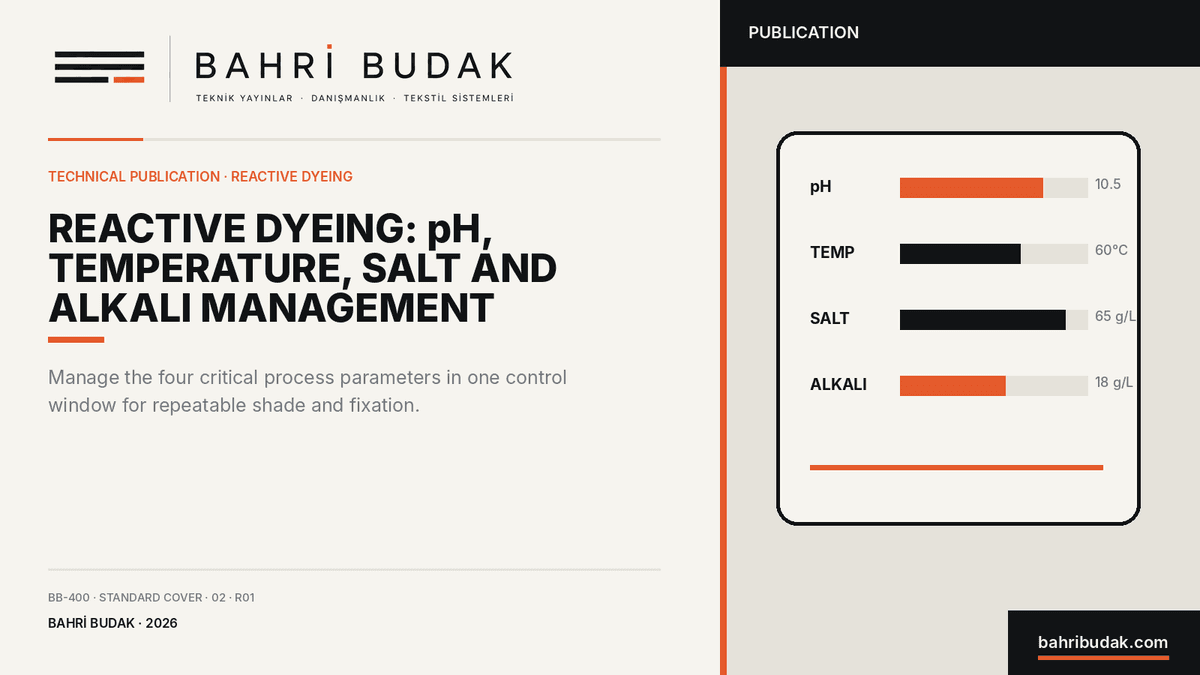
pH, Temperature, Salt and Alkali Management in Reactive Dyeing
Explains the integrated management of pH, temperature, electrolyte, alkali, liquor ratio and dosing profile in exhaust reactive dyeing of cotton and other cellulosic materials.
Finishing
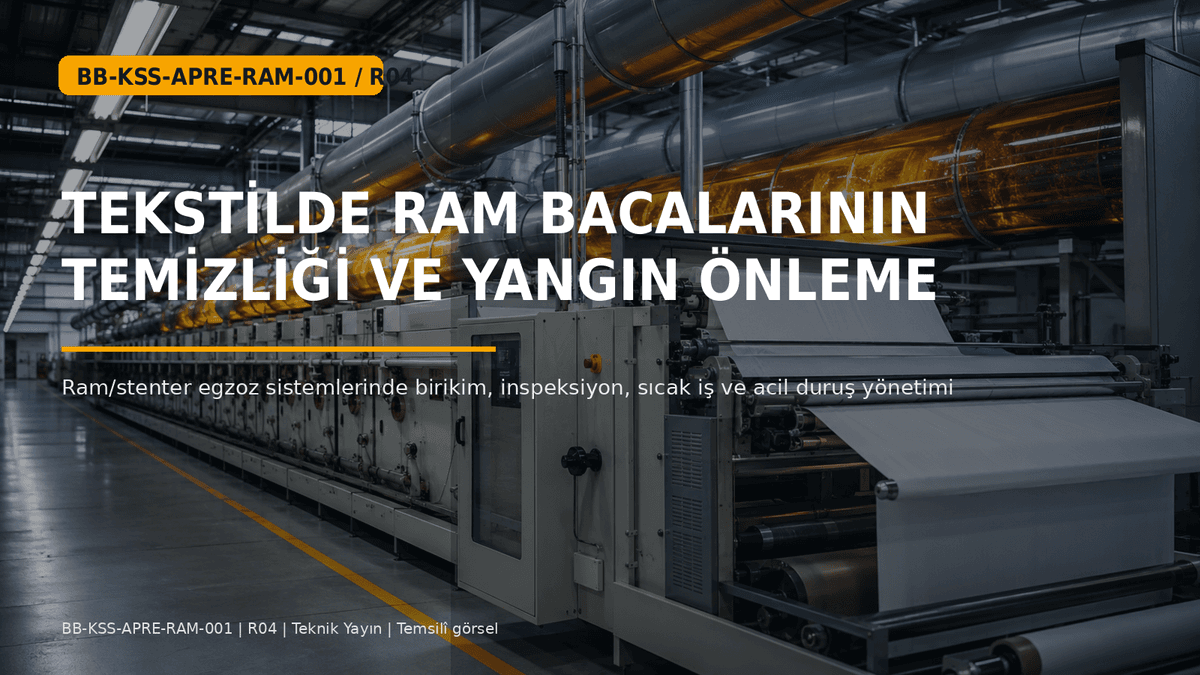
Stenter Exhaust Cleaning and Fire Prevention
Explains how to control lint, oil, wax and aerosol deposits in stenter exhaust systems and manage inspection, cleaning, hot work and emergency response.
Bahri Budak
Technical publications, training and process consulting based on more than 35 years of field experience in Knitting, Dyeing and Finishing.
LinkedIn →